Config-Based Checks
Execution of checks based on a configuration file is designed to optimize the speed of running multiple checks for many workspaces at once.
All checks are executed in a single pass, each file is read and parsed only once, which allows for significant resource savings.
Additionally set of detectors for each workspace is executed in parallel and particular detectors within each workspace are also executed in parallel utilizing all available CPU cores in optimal way.
Adding more detectors usually increases overall execution time only by few milliseconds, which makes rev-dep an excellent choice for huge monorepos.
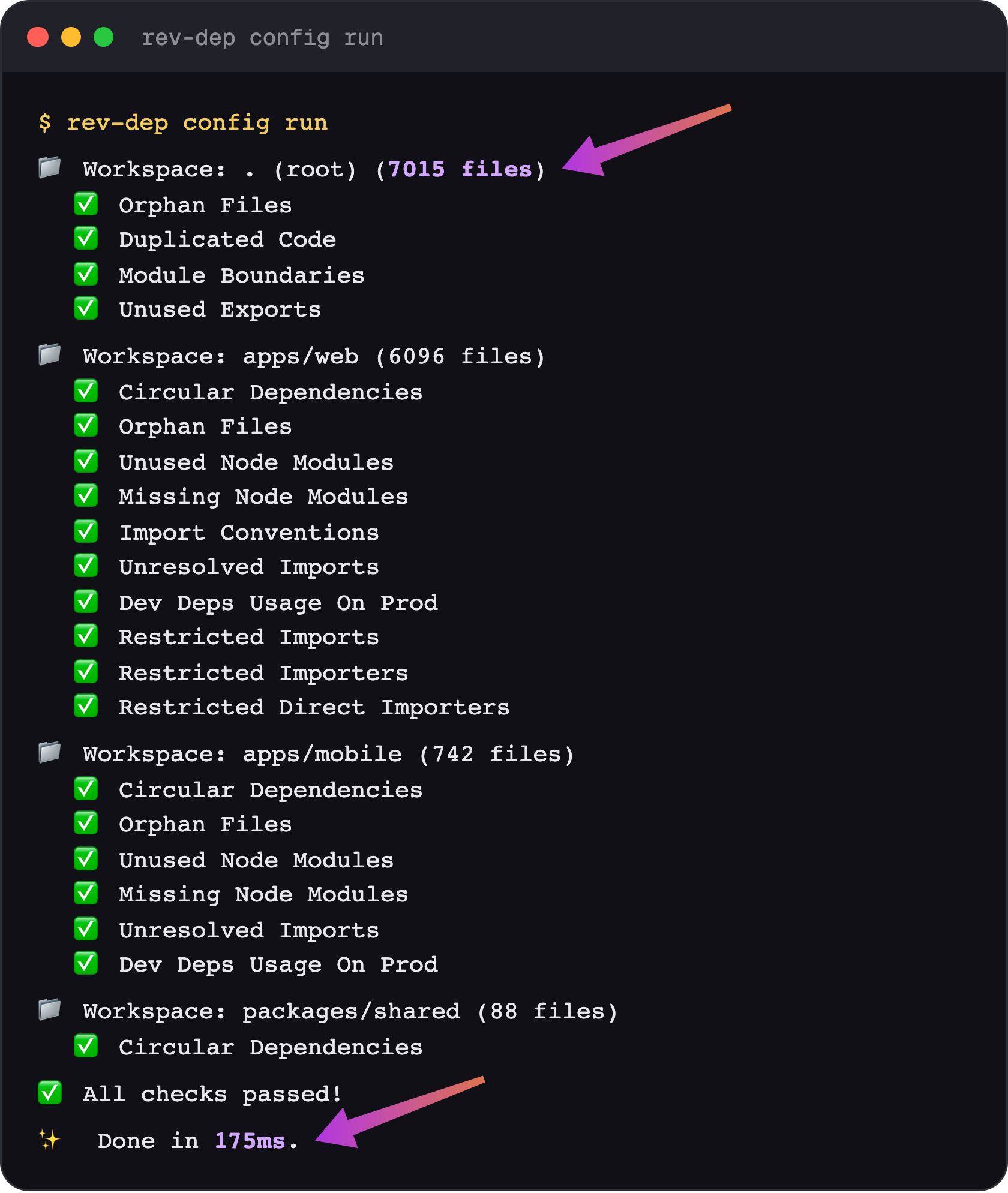
Checks overview
Available checks are:
moduleBoundaries- enforce architecture boundaries between modules.restrictedImportsDetection- block importing denied files/modules from selected entry points.restrictedImportersDetection- whitelist which entry points may transitively reach a set of files/modules.restrictedDirectImportersDetection- constrain which files may directly import a set of files/modules (non-transitive).importConventions- enforce import style conventions (offers autofix).circularImportsDetection- detect circular imports.duplicatedCodeDetection- detect copy-pasted code blocks and JSX elements.orphanFilesDetection- detect dead/orphan files (offers autofix).unusedExportsDetection- detect exports that are never used (offers autofix).unusedNodeModulesDetection- detect dependencies declared but not used.missingNodeModulesDetection- detect imports missing from package json.devDepsUsageOnProdDetection- detect dev dependencies used in production code.unresolvedImportsDetection- detect unresolved import requests.
Acknowledge existing findings
Use a findings baseline to keep CI clean while existing issues are acknowledged. Configure baselineSnapshotPath, record it with rev-dep config run --update-snapshot, and commit the file. Subsequent runs fail on new or obsolete findings. Duplicated code retains its own specialized snapshots.
Next steps
New to config-based checks? Follow a step-by-step setup with the: